— Spanish · Learning habits
A seven-day Spanish vocabulary routine you can start tomorrow
Start with five useful Spanish expressions and a place in your day to revisit them. This first-week plan gives you a small task each morning, with time to remember earlier words before adding more.
Tonight: choose five words you will use
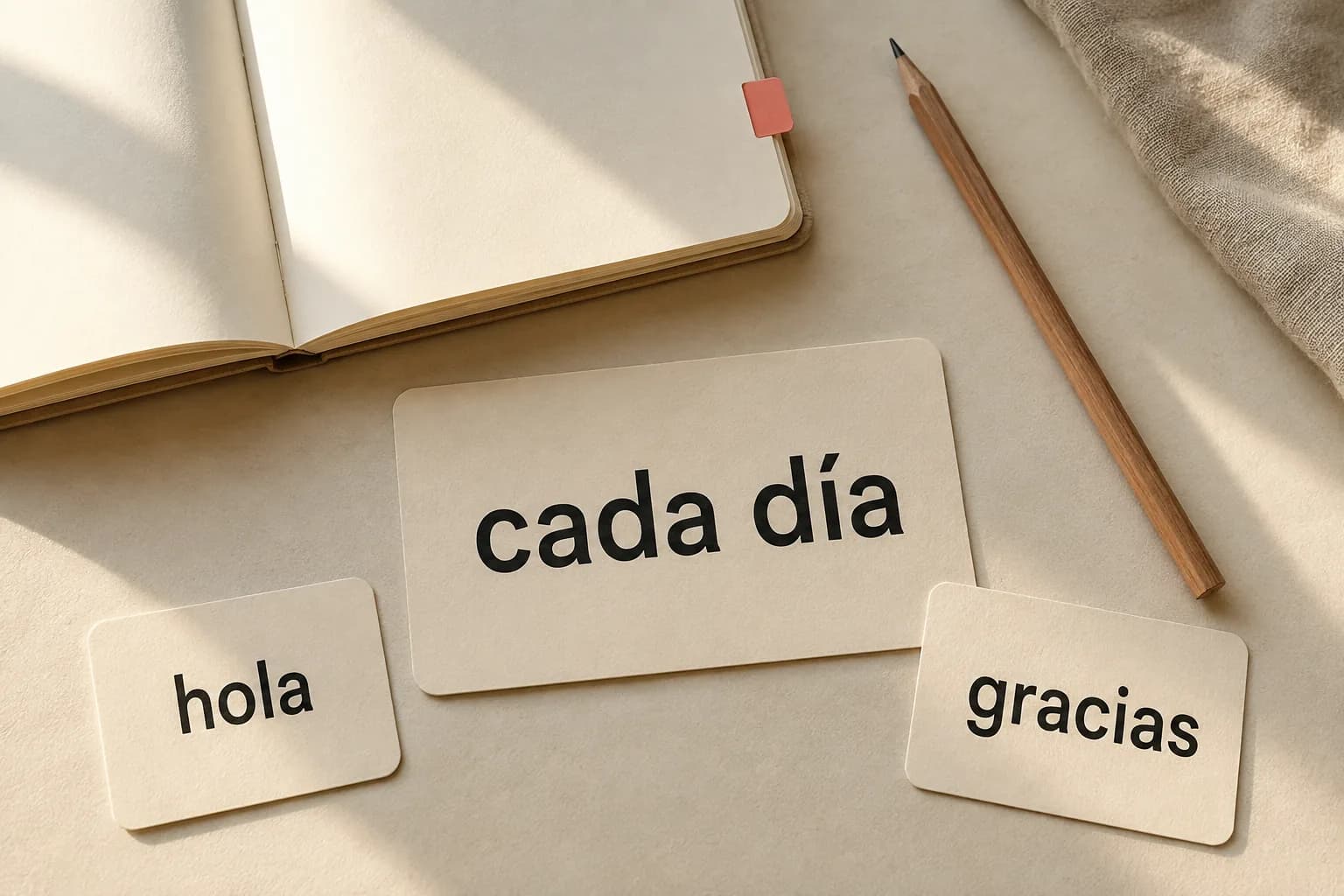
Choose one small topic: your breakfast, your commute, or ordering in a café. Our morning vocabulary guide and travel phrase guide both include downloadable decks, but you do not need to study a whole deck at once. A notebook works too.
For example, start with la alarma, levantarse, el desayuno, el café, and salir de casa. Write a short meaning beside each one. Add one example you understand, such as Me levanto a las siete: “I get up at seven.” If a sentence is too complicated to explain, simplify it.
Pick a repeatable cue, such as finishing breakfast or dismissing your alarm. Morning is a convenient cue for this plan; you can use another time if it fits your life better.
Use the same short session each day
Give yourself about five minutes. The time limit is a practical starting point, not a required dose or a promise of a particular result. Try to retrieve an answer before checking it, and make room for words you missed.
- Recall: look at the English meaning and try saying the Spanish without checking the answer.
- Check: compare your answer with the word or phrase. Notice the article, accent, or verb form you missed.
- Use: say or write one short sentence with a word you reviewed.
- Return: mark the difficult entries so they come back in your next session.
Your first seven days
This is a suggested pace. Add fewer words if recall feels difficult. Repeating a set is a complete study session; there is no need to introduce new vocabulary every morning.
- Day 1 — Meet your first five. Read the meanings and examples, then cover the Spanish and try each once. Check every answer.
- Day 2 — Recall the same five. Give extra attention to misses. Change one example to describe your own morning.
- Day 3 — Add up to five related entries. Review the original set first. Keep the new words within the same topic so you can use them together.
- Day 4 — Mix both sets. Change their order and alternate between Spanish-to-English recognition and English-to-Spanish recall.
- Day 5 — Practice your difficult entries. Say a sentence with each. Check a spoken example if you are unsure how a word sounds.
- Day 6 — Revisit everything. If the current set feels comfortable, introduce up to five more; otherwise, stay with what you have.
- Day 7 — Check what remains. Try every entry before looking at its meaning. Choose the words that need another week and write three sentences using the ones you remember.
Why the plan includes so much review
Recognizing a word on a page and producing it without help are different tasks. Covering the answer lets you see which one you can do. Checking afterwards gives you a chance to correct a mistake before practicing again.
A review by Dunlosky and colleagues rated practice testing and distributed practice as high-utility learning techniques. The practical ideas here are to try recalling information and to spread practice across sessions. The exact seven-day schedule above is our suggested routine, not a schedule tested in that review.
Read the Association for Psychological Science overview of the learning-techniques review.
Make your alarm the reminder
In LingoAlarm, you can select Spanish and a beginner level for an alarm, or use a custom vocabulary list. You answer vocabulary questions to finish the alarm quiz. The app brings missed words back through spaced repetition, so the selection will not follow the manual calendar above exactly.
Use the alarm quiz as the start of practice, then make up a sentence with one of its words once you are up. For words you want to use in conversation, add listening and speaking practice during the day.
New installations include seven free learning mornings. Only the first completed quiz of a day uses a morning, and skipped days do not count. After those mornings, Pro is needed to keep vocabulary quizzes in future alarms; ordinary alarms continue with slide to dismiss. The articles and downloadable decks remain free to read and use.
What to do after the first week
Choose your next topic from something you expect to say. If breakfast words feel familiar, move to your commute or a café order. Keep older words in the rotation instead of replacing the entire set every week.
If you miss a day, return to the difficult entries at your next session. Adjust the set size if starting feels like a chore. A useful sign of progress is being able to recall an expression and use it in a sentence of your own.