— Spanish · Everyday vocabulary
20 Spanish words and phrases for your morning routine
Your alarm, your coffee, your keys: a morning gives you plenty of things to talk about in Spanish. Start with the words for what you actually do, then put a few of them into a sentence about tomorrow.
Waking up and getting ready
These verbs appear in their dictionary form. The ending -se in despertarse, levantarse, ducharse, and vestirse becomes me when you describe yourself in the present tense: me despierto, me levanto, me ducho, me visto. Learn one useful example alongside each verb instead of trying to memorize every conjugation at once.
Keep the article with a noun when you learn it: la cama, not just cama. It gives you the noun’s grammatical gender as part of the same memory.
| Spanish | English | Use it |
|---|---|---|
| la mañana | the morning | Por la mañana means “in the morning.” |
| la alarma | the alarm | Mi alarma suena: my alarm rings. |
| despertarse | to wake up | Me despierto a las siete: I wake up at seven. |
| levantarse | to get up | Me levanto: I get up. |
| la cama | the bed | Salir de la cama: to get out of bed. |
| ducharse | to take a shower | Me ducho: I take a shower. |
| vestirse | to get dressed | Me visto: I get dressed. |
| el baño | the bathroom | Estoy en el baño: I am in the bathroom. |
Breakfast and the first drink of the day
Spanish has a single verb for having breakfast: desayunar. You can say desayuno at the start of a sentence to mean “I have breakfast.” With an article, el desayuno is the noun “breakfast.” Context tells you which one you are reading.
The accent in café marks the stressed final syllable. Keep accents when you write your cards; they are part of the spelling.
| Spanish | English | Use it |
|---|---|---|
| el desayuno | breakfast | El desayuno está listo: breakfast is ready. |
| desayunar | to have breakfast | Desayuno en casa: I have breakfast at home. |
| el café | coffee | Un café con leche: a coffee with milk. |
| el té | tea | Tomo té: I drink tea. |
| el pan | bread | Pan con mantequilla: bread with butter. |
| la leche | milk | Sin leche: without milk. |
Getting out of the door
Add one time phrase to make your sentence more specific. Temprano and tarde can describe whether you leave early or late: salgo temprano, salgo tarde. You do not need to change their endings in these sentences.
| Spanish | English | Use it |
|---|---|---|
| las llaves | the keys | ¿Dónde están las llaves?: where are the keys? |
| la mochila | the backpack | Mi mochila: my backpack. |
| salir de casa | to leave home | Salgo de casa: I leave home. |
| ir al trabajo | to go to work | Voy al trabajo: I go to work. |
| temprano | early | Me levanto temprano: I get up early. |
| tarde | late | Salgo tarde: I leave late. |
Two distinctions that make your Spanish clearer
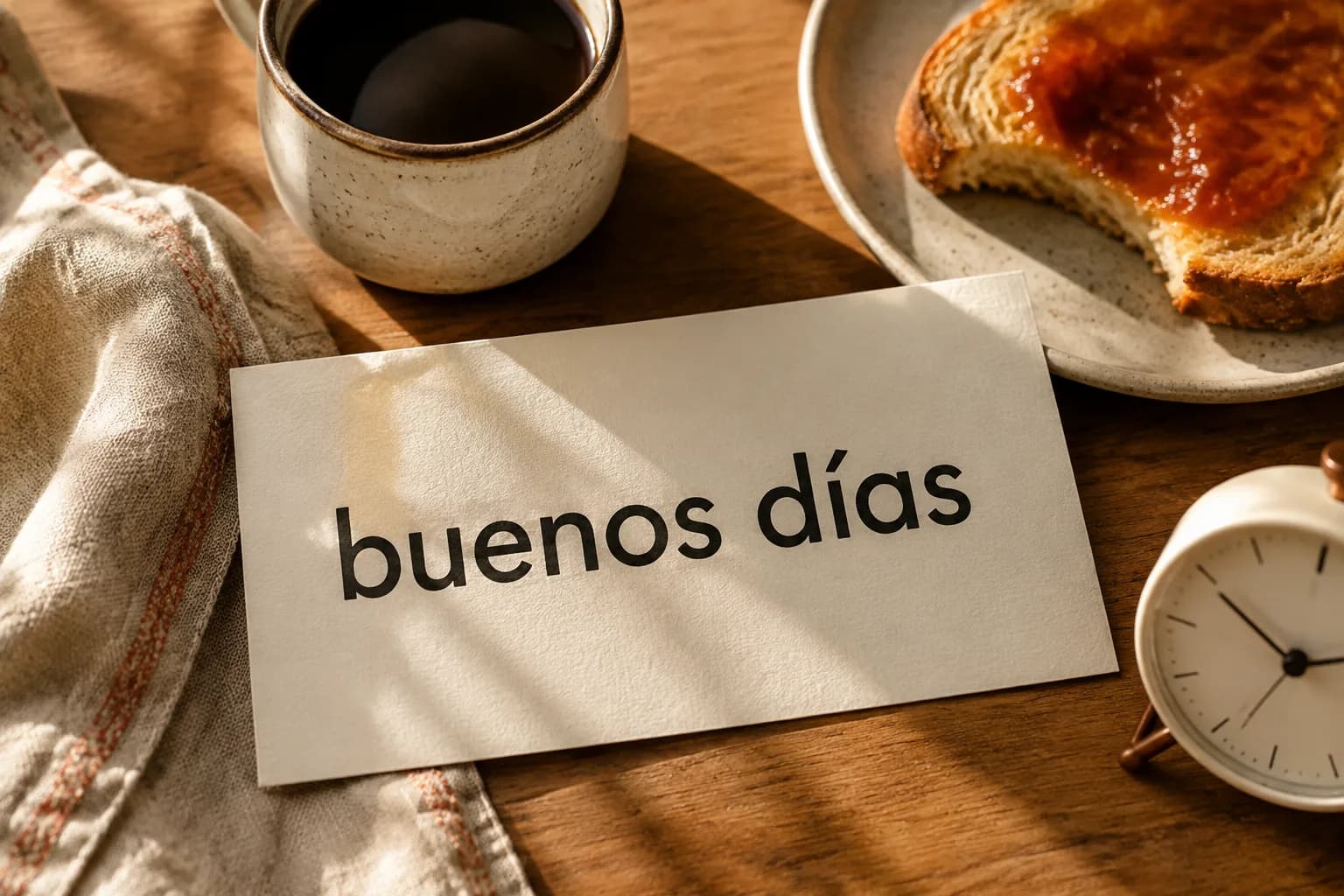
Waking up and getting up are different actions. Me despierto a las siete means you wake at seven. Me levanto a las siete y diez means you get out of bed at ten past seven. If your alarm rings while you are still in bed, despertarse is the word for the first part.
Mañana can mean “morning” or “tomorrow.” Por la mañana means “in the morning”; mañana por la mañana means “tomorrow morning.” Tarde has a similar contextual shift: salgo tarde means “I leave late,” while por la tarde means “in the afternoon.”
Describe your own morning
Read this once, then change the time, drink, or destination to match your life. A sentence you can actually use is a good starting point for tomorrow’s review.
— Try saying it
Me despierto a las siete. Me levanto, me ducho y desayuno en casa. Tomo café con leche. Salgo de casa a las ocho.
I wake up at seven. I get up, take a shower, and have breakfast at home. I drink coffee with milk. I leave home at eight.
- Choose five entries from the tables. Read each Spanish expression and its meaning.
- Cover the Spanish column. Try to say each expression from its English meaning, then check it.
- Write one sentence about your morning using two of the entries. Keep the example nearby if you need help with a verb.
- Come back tomorrow and try those same five before choosing any new words.
— Keep practicing
Take the vocabulary with you
Get the Spanish expressions and English meanings from this guide as a free CSV. No email or account needed for the download. Import it into a Spanish custom list in LingoAlarm, or use it with your own study tools.
On the web dashboard, open a Spanish list and use its file import. In the mobile app, open your list’s import screen and paste the CSV text. Keep English as your base language for these English translations.
Download the 20-entry morning deck